The Key to B2B Sales Success: Practical Techniques for Business Card Scanning and CRM Integration at Exhibitions
At Japan IT Week 2026, business card management is a strategic process impacting sales, where CRM integration ensures speed, accuracy, and automation to turn interactions into results.
1. Business Card Apps as the “Ultimate Weapon” for Sales Teams
Implementing a business card management app goes beyond operational efficiency and directly enhances sales performance by transforming how information is captured, shared, and utilized across the team.
One of the most immediate benefits is the elimination of manual input workload, as sales representatives no longer need to spend hours entering hundreds of business cards at the end of the day, reducing processing time by up to 90% and allowing them to focus on meaningful customer conversations instead of repetitive administrative tasks.
At the same time, these apps enable the digitalization of deal context by allowing users to instantly record booth conversations, capture notes, or even convert voice input into text, ensuring that critical details are preserved and easily shared across the team, rather than being lost or fragmented.
Mobility is also significantly improved, as digital business cards such as vCards can be sent instantly on-site, lowering the barrier for follow-up and enabling smoother communication immediately after initial contact.
Finally, the use of advanced AI-OCR technology enhances brand perception, as it signals that the company is actively embracing digital transformation, thereby increasing credibility and trust, particularly in IT-focused environments.
2 Pre-Event Preparation: Building a Data Infrastructure
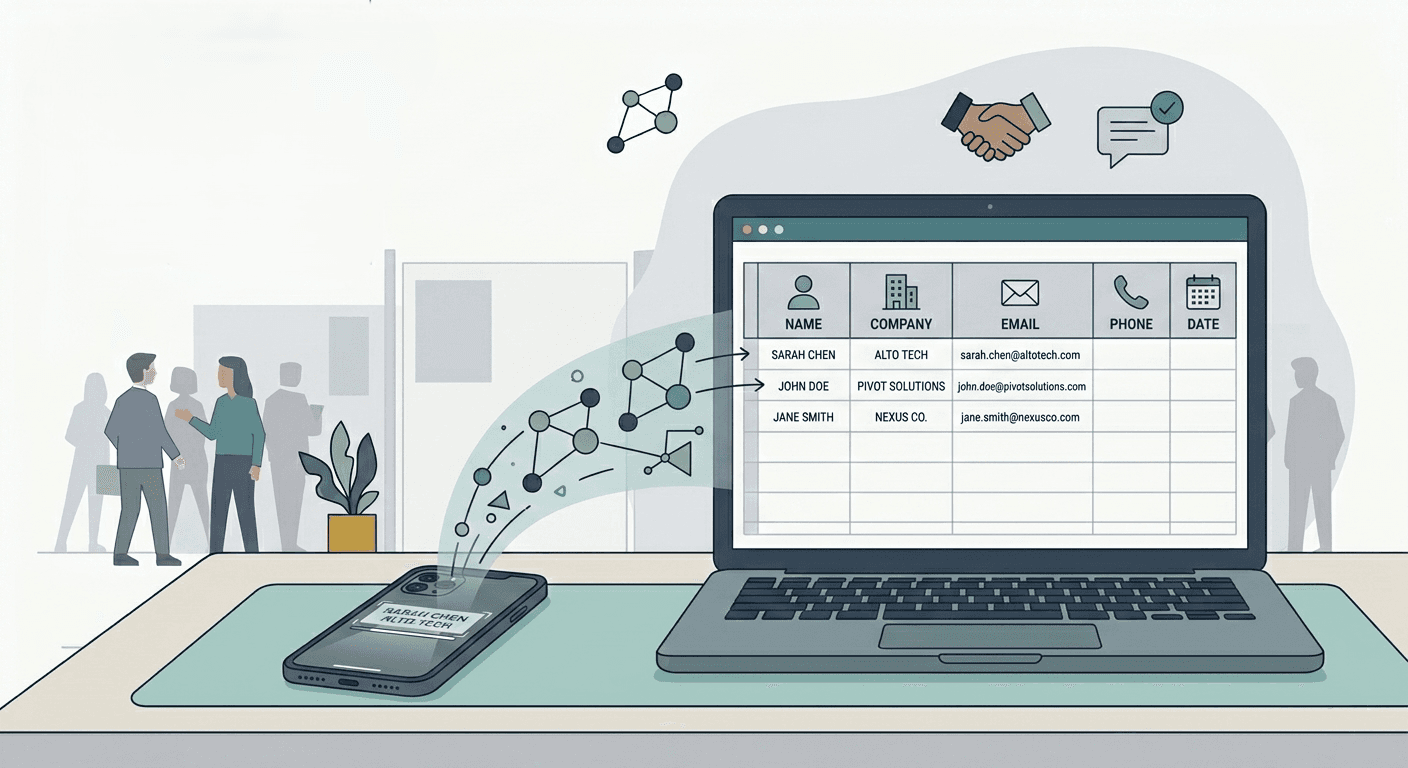
Success at the exhibition floor is largely determined before the event begins, making it essential to establish a solid data infrastructure in advance that supports fast and consistent operations.
This starts with selecting the right application, prioritizing tools that offer high-speed scanning, multilingual support, and offline functionality, such as Boxcard or Eight, ensuring that performance remains stable even in crowded or low-connectivity environments.
Equally important is the setup of a clear tagging system, where categories such as “Interested in Cloud,” “Looking for Offshore Development,” or “Considering AI Adoption” are predefined, allowing leads to be classified instantly during interactions without requiring additional processing later.
In addition, CRM integration must be tested beforehand, including automatic synchronization with platforms like Salesforce or HubSpot, so that any potential issues are identified and resolved prior to the event, preventing disruptions during critical moments.
3. On-Site Workflow: “Scan, Note, Tag”
Effective on-site operations require a balance between respecting Japanese business etiquette and maximizing digital efficiency, which can be achieved through a simple but disciplined workflow.
After exchanging business cards, scanning should be performed using an AI-powered camera once the visitor has stepped away from the booth, maintaining professionalism while ensuring immediate data capture.
Key details such as the prospect’s challenges, budget expectations, and timeline should then be recorded quickly using voice input or note functions, preserving context while it is still fresh.
Finally, leads should be tagged based on priority levels such as A, B, or C, as well as areas of interest, allowing the team to maintain lead quality and act accordingly.
By following this process, sales teams can move seamlessly from collection to evaluation to action without bottlenecks.
4. CRM Integration: Turning Static Data into Active Opportunities
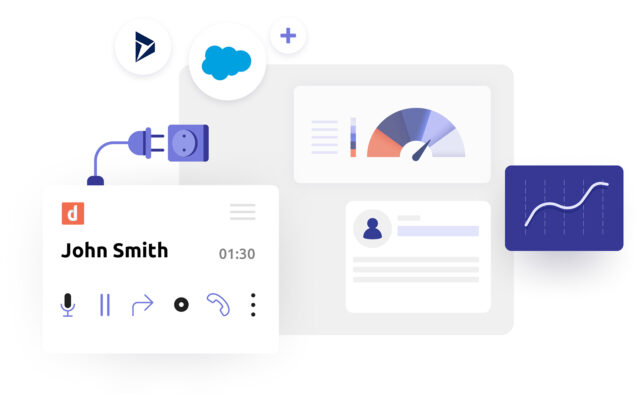
Business cards only become valuable when they are integrated into a system that enables action, and CRM platforms play a central role in transforming static data into dynamic sales opportunities.
Through automated synchronization, scanned data can be reflected in real time within CRM pipelines, eliminating delays and enabling immediate visibility across the organization.
Data cleansing processes further enhance quality, as AI automatically standardizes formats for phone numbers and email addresses while removing duplicates by matching against existing records.
At the same time, centralized data sharing ensures that all team members have access to updated lead information, preventing duplicate outreach and minimizing the risk of missed follow-ups.
5. Lead Export and Follow-Up Strategy
The true value of collected business cards is realized after the exhibition, when structured data is used to drive targeted and timely follow-up activities.
Leads can be exported based on specific segments, allowing teams to create tailored email campaigns or webinar invitations that align with each prospect’s needs and interests.
A multi-channel approach further increases engagement rates by combining email outreach with platforms such as LinkedIn and direct phone calls, ensuring multiple touchpoints.
In addition, AI-driven lead scoring enables automated prioritization, allowing sales teams to focus first on high-value A-ranked leads while maintaining efficiency across the pipeline.
6. Risk Management and Security in the Japanese Market
In Japan, compliance with the Act on the Protection of Personal Information (APPI) is a fundamental requirement for building trust, making proper data management a critical component of exhibition strategy.
Business card data should be treated as a corporate asset, stored centrally on company servers rather than remaining on individual devices, ensuring consistency and security.
Access control must be carefully managed, particularly when interpreters or temporary staff are involved, with permissions limited as needed and data either deleted or consolidated after the event.
Encryption and regular backups are also essential, ensuring that sensitive information is protected during transmission and can be recovered in case of system failures.
7. A Simple and Easy-to-Use Business Card App: BoxCard

For those who feel that business card management apps are often complex, slow, or eventually require payment, Boxcard offers a practical alternative by combining simplicity, lightweight performance, and free access into a single solution that is accessible even for first-time users.
The app is designed to be intuitive, allowing anyone to start scanning immediately without a learning curve, while its lightweight architecture ensures smooth performance without delays or system strain.
Despite being free, it provides essential features such as scanning, organizing, searching, and sharing business card data, eliminating concerns about hidden costs that are common with other applications.
It also supports multiple languages, including Japanese, English, Vietnamese, Korean, and Chinese (both Simplified and Traditional), with additional languages planned in future updates, making it particularly suitable for international business environments.
Compared to many other apps that are feature-rich but heavy, complex, and often paid, BoxCard focuses on delivering only what is necessary in a streamlined and efficient way, allowing users to manage business cards comfortably without unnecessary friction.
This makes it especially valuable for businesses handling multilingual cards or engaging in cross-border transactions, where ease of use and flexibility are essential.
It is particularly recommended for:
- ・Users trying a business card management app for the first time
- ・Those who want to organize cards efficiently without cost
- ・Professionals dealing with multilingual business cards
- ・Users who prefer simple and lightweight tools over complex systems
- 👉 Download BoxCard now on the App Store or Google Play and start managing your business cards more efficiently.
Success at Japan IT Week 2026 depends on transforming collected business cards from static information into valuable leads through fast and accurate digitization powered by AI-OCR and immediate CRM synchronization, while consistently applying the on-site workflow of scanning, noting, and tagging to accelerate follow-up, enabling sales teams to maximize ROI within a short timeframe; at the same time, ensuring compliance with Japan’s data protection regulations strengthens trust and supports long-term relationship building, making it essential to strategically combine the right business card management app with CRM integration in order to convert the momentum of the exhibition into tangible sales outcomes.
