Business Card Exchange Etiquette Across Asia: Japan, Korea, China, and Singapore
If you will meet people from Japan, Korea, China, and Singapore on one trip, use a short set of decisions: which card to carry, whether to present formally, and how you will digitize contacts. This article offers concrete rules, phrases, and a brief workflow to avoid common mistakes and follow up correctly.
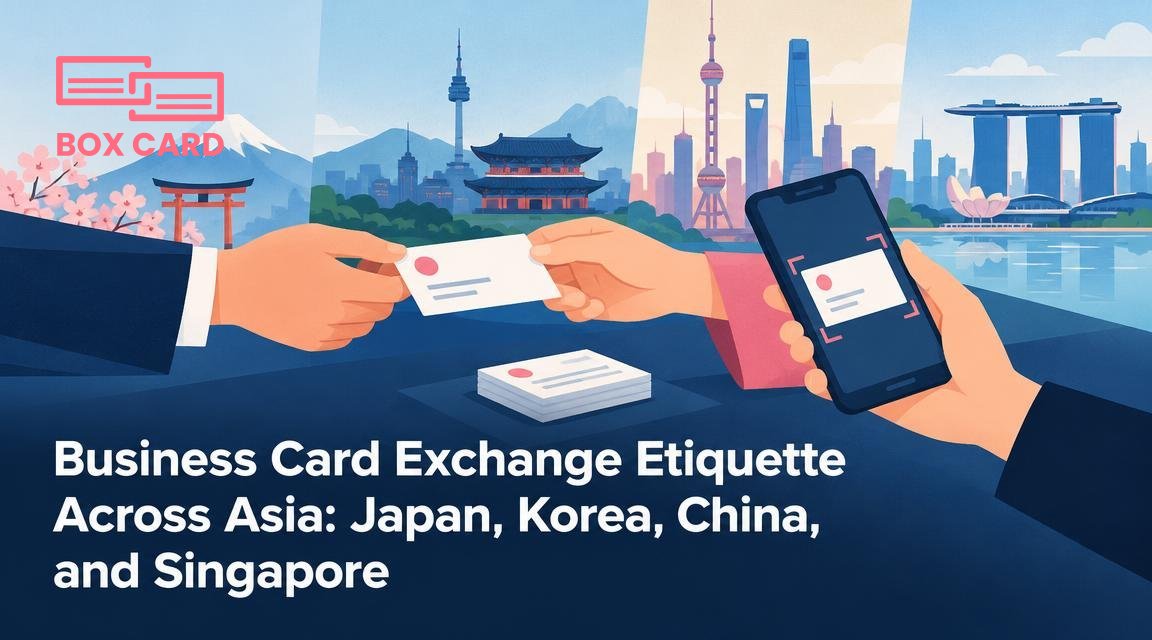
You are traveling through Tokyo, Seoul, Shanghai, and Singapore on one trip. You will meet people from several companies, and you need a clear, repeatable approach so you do not offend anyone or lose vital contacts. This article gives rules you can apply in mixed settings, concrete phrases to use, and a short workflow for handling cards during and after meetings.
Three simple decisions to make before every meeting
When you have limited time between flights, settle these three things in advance. They determine how smoothly exchanges will go.
- Which card to carry: always bring at least two stacks, one in English and one in the local language where possible. If you must choose one, carry the card that matches the primary language of the person you expect to meet.
- Presentation style: default to the most formal style you expect to meet, then relax if the other person signals informality. Formal means two-handed presentation and a brief pause for the recipient to read the card.
- Digitize plan: decide whether you will capture cards by photo during the meeting or preserve originals for later scanning. If you plan to photograph cards, have a neutral surface and permission ready.
Country differences that change what you do at the table
These are practical, behavior-first descriptions. The goal is not to memorize every rule but to recognize the signposts that tell you how to act in a given interaction.
Japan: follow ceremony, show the card respect
Japan business card etiquette centers on respect and hierarchy. Present your card with both hands, holding it by the top corners so the recipient can read it. If someone gives you a card, receive it with both hands, study it briefly, and place it carefully on the table in front of you, facing the giver when possible. Do not put someone elses card into your back pocket or hide it. If you must step away, place the card in a dedicated cardholder or a notebook; do so visibly and with care.
Quick decision rule: when in doubt, use two hands and pause to read. That small pause signals attention and respect.
Korea: formality with flexibility
Korean business exchanges look similar to Japan but with more variation depending on age and corporate culture. Two-handed presentation and reception are common when interacting with a senior person. Younger professionals and startups may use a single-handed exchange with a handshake. Titles matter, so take a moment to confirm pronunciation or the equivalent English title if needed.
Quick decision rule: mirror the most senior person in the room. Offer two hands if they do; otherwise match a single-handed presentation.
China: watch for hierarchy and language cues
In China, titles and company position matter strongly. A one-handed card offer is common, but presenting or receiving with both hands is a clear sign of extra respect for senior counterparts. Take time to read a received card, and do not write on it in front of the giver. If a card is printed in Chinese characters, ask for the preferred English spelling of the name and the correct pronunciation before the person leaves the room.
Quick decision rule: use the card as an information cue. If you cannot read the card, ask politely for the name pronunciation and a business card in English if needed.
Singapore: multicultural and pragmatic
Singapore business card etiquette is less formal overall, reflecting the citys multicultural business environment. A handshake with a single-handed exchange is common, but many professionals will appreciate a more formal approach if you start that way. Always adapt in real time: a Chinese or Japanese visitor in Singapore may expect their own cultural norms to be observed.
Quick decision rule: start neutral, then adapt. Offer a card with one hand and read the recipients body language. If they respond with both hands, mirror that.
What to do when a meeting involves people from different cultures
Mixed meetings are the most common source of uncertainty. Use this short checklist to keep the exchange respectful and efficient.
- Identify seniority fast: when introductions start, watch seating order and who speaks first. Offer cards to senior people before others, or wait for them to request one.
- Offer a bilingual card if you have one: that removes friction and shows cultural awareness. If you only have one language on your card, mention the correct pronunciation of your name when you hand it over.
- When two styles appear at once: if one person offers two hands and another reaches with one, present with two hands toward the more formal person, then make eye contact and offer a brief handshake to the rest.
- Seating and card layout: if cards are placed on the table, arrange them in the seating order aligned with your side of the table so you can review them later in context. Photograph the arrangement if that helps recall who belongs to which card.
Handling the cards after the meeting
How you treat cards once you leave the room affects impression and follow-up. Use this short workflow.
- Immediate actions while still at the table: glance at each card, note the correct pronunciation or title, and, where appropriate, ask one clarifying question about role or project. Do not write on a card without permission.
- Organize physically: place cards in a business card holder rather than stuffing them in a pocket. If you collected many cards, keep them in the order you received them or in seat order so you can follow up correctly.
- Digitize within 24 hours: use a reliable app for business card scanning and business card OCR to capture names, companies, titles, and notes while the meeting is fresh. Photograph the table arrangement first if that helps preserve context.
- Follow-up message: send a short, specific email or message within 48 hours. Mention the topic you discussed, the meeting date and place, and one action point. If the person shared a paper card with a local script, include the name both as it appears on the card and in Latin script if you have it.
Common mistakes and how to recover
- Forgetting a local-language card: apologize briefly and offer to send your contact details by message in the persons preferred language, or ask whether they prefer email or an app contact transfer. Preparing a digital vCard makes this easy.
- Putting a card in your pocket immediately: if you already did this, during a polite moment take the card out, examine it, and place it respectfully in your holder while saying something like, "Thank you, I will keep this with care." That acknowledges the earlier mistake without drama.
- Writing on someones card in front of them: apologize and explain you were taking a private shorthand note. Offer to transcribe it to your digital notes and show the action to reassure them.
- Mispronouncing names repeatedly: stop and ask for the correct pronunciation, then repeat it back. People usually appreciate the effort if you try carefully.
Practical items to pack and phrases to know
Pack a slim card case, a few bilingual cards, and an app on your phone prepared for quick scans. Learn these short phrases to use when exchanging cards.
- "May I give you my card?" Use this if you are unsure whether to present a card first.
- "Could you tell me how you prefer your name written in English?" Useful when the card is in Chinese, Korean, or Japanese characters.
- "Do you prefer email or WeChat/WhatsApp for follow-up?" Asking this makes your follow-up more likely to land correctly.
Bring a business card holder rather than loose envelopes. If you plan to scan later, set aside time the same day for business card scanning using an app with OCR so you do not lose context.
When you travel across multiple Asian markets, start formal and adjust quickly. Respect is shown by attention to detail, not by perfection.
Before your next multi-city trip, prepare two stacks of cards, rehearse the short phrases above, and choose one digitization method to use consistently. That routine turns cultural differences from obstacles into predictable steps you can handle under time pressure.