Business Card Culture in Hong Kong: How to Make a Professional First Impression
Want to make a professional first impression in Hong Kong? Use a clear bilingual business card, present it politely, scan and follow up within 48 hours. This article gives concrete card design, exchange, and follow-up rules that work across sectors.
You have one short moment after introductions to make a professional impression in Hong Kong. The wrong card, the wrong language, or an impolite exchange can create friction before the conversation even begins. This article shows how to design the right card for Hong Kong, how to exchange it in person, when to offer a digital option, and exactly what to do after the meeting to turn that card into a real business contact.
What matters first: respect, clarity, and context
Hong Kong mixes Cantonese Chinese business customs with international, English-speaking habits. That combination matters for two decisions you must make before the meeting. First, how formal will the meeting be? Second, who is in the room: local executives, visiting foreigners, or a mixed team? The answers determine language, card layout, and how you offer contact details.
Designing a Hong Kong business card that works
Your design should answer three practical questions at a glance: who are you, what do you do, and how should someone contact you. Beyond that, follow these concrete choices.
Language and characters
- If you expect local professionals, include Traditional Chinese characters for name and title. Mainland simplified characters are common elsewhere, but Hong Kong primarily uses Traditional Chinese.
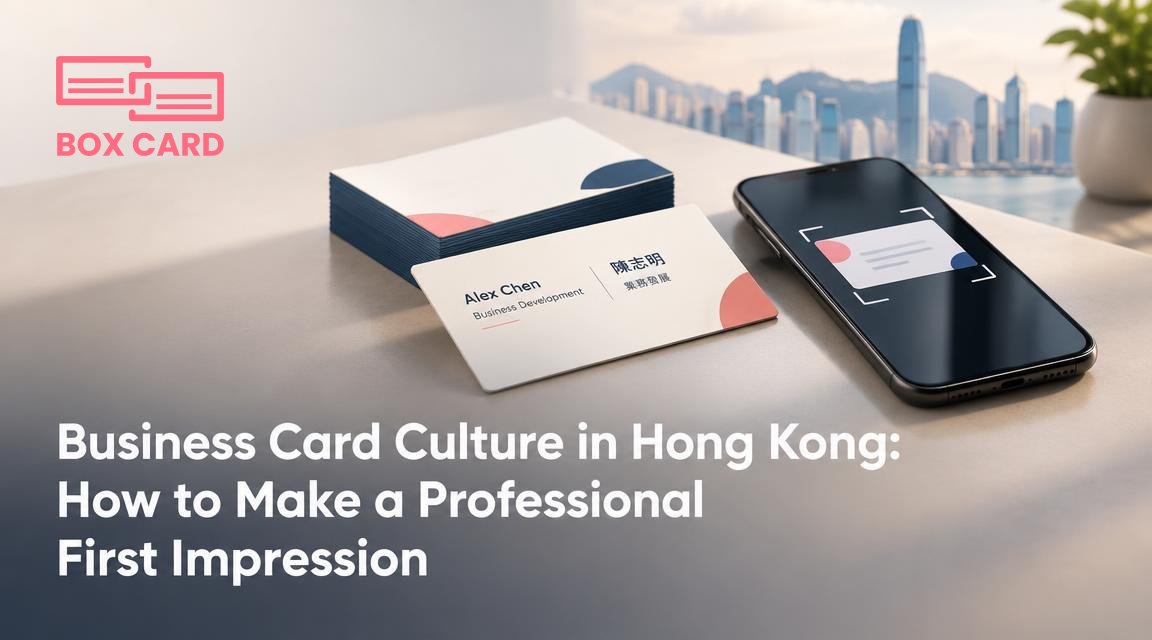
- For mixed or international audiences, make it a bilingual business card: put English and Chinese on the same side or use English on the reverse. A common pattern is Chinese on the left or top and English on the right or bottom, so each reader finds their language quickly.
- Name order: present your name in the form your audience recognizes. If you are ethnically Chinese, you may choose Chinese order (family name first) on the Chinese side and Western order on the English side. Be consistent so recipients can save the contact correctly.
Titles, company name, and accuracy
Use the title the recipient is likely to understand. In finance and professional services, formal titles matter. In startups and creative industries, a short explanatory phrase like Product Lead or Creative Director is fine. Avoid internal jargon or fanciful titles that mean little outside your company. Always print the official company name clearly, and check spelling carefully.
Contact fields and formatting
- Phone numbers: include the country code, for example +852 for Hong Kong, and show the mobile number plainly. When you expect mainland China contacts, also consider adding WeChat ID on the card, since many professionals use WeChat for business there.
- Email and website are standard. If you use WhatsApp or Telegram as primary channels, include them, but place them after phone and email.
- QR codes: add a single QR code that links to a vCard, LinkedIn profile, or company page. Keep the QR code unobtrusive and on the back if you have bilingual text on the front.
- Avoid clutter: two languages, a QR code, and three contact channels usually fits well on a standard credit-card size.
Paper, finish, and legibility
Print on sturdy card stock with good contrast. Small, pale text becomes hard to read quickly. Avoid heavy decoration that hides essential information. If you use special finishes, reserve them for senior-level or strategic introductions where a tactile impression helps, such as a first meeting with a potential investor or a key client.
How to exchange cards in Hong Kong, step by step
Clarity and small courtesies matter more than rigid ritual. Follow these steps to avoid awkwardness.
- When you meet, establish names and roles first. If you plan to give a card, say politely as you offer it in English or Cantonese, for example, "May I give you my card?" This prepares the recipient.
- Present the card face up, with the text oriented toward the recipient. Using both hands is common when meeting Chinese counterparts and signals respect, but a single handed offer is acceptable in many business settings. When in doubt, use both hands in formal introductions.
- If you receive a card, take a moment to look at it. Scanning it quickly shows respect, and it helps you remember details for the conversation that follows. Avoid immediately shoving it into your pocket or writing on it in front of the giver.
- Where to keep cards during the meeting: place cards you receive on the table in front of you, arranged by seniority or focus, or keep them in a clean card holder. Do not fold or write on someone else’s card in front of them.
Different settings require different approaches
Hong Kong covers a wide range of business styles. Choose your approach depending on the sector and the meeting format.
Banking and legal meetings
Use a conservative design, bilingual text, and formal titles. Hand the card with both hands and inspect cards you receive carefully. Follow up with a polite, concise email referencing the meeting and any immediate next steps.
Tech startups and creative industries
Design can be more casual. One-sided English cards are often acceptable if the audience is international, but carry a bilingual card if you expect local partners. In startup pitch settings, a quick QR code to a digital portfolio or deck can be helpful.
Trade shows and networking events
Expect rapid exchanges. In large crowds, you may switch to digital business cards or QR-based sharing to avoid dropping or losing cards. If you still collect physical cards, scan them immediately after the event using a card scanning app or a dedicated scanner.
When to offer a digital option and how to do it well
Digital business cards are increasingly common, but they do not replace the physical card in all situations. Use them strategically.
- Offer a digital card when: time is short, you are exchanging contacts at a conference, or the other person asks for a quick way to save your details. Digital is also useful when travel or sustainability is a concern.
- Keep the same information: the digital card should mirror your physical card so recipients can match the two easily. Include the same name ordering, titles, and contact channels.
- Single QR code approach: keep one QR code on your physical card that points to a digital profile or vCard. This avoids duplicate codes and makes it simple for the receiver to save you directly.
- Use a reliable scanning or management tool: if you plan to collect many cards, use a business card scanning app to capture details accurately and reduce manual entry work. An app that preserves the original card image and lets you add tags, meeting notes, and follow-up reminders will save time after meetings.
From card to contact: follow-up that converts
A card exchange is only useful if you act on it. Follow these steps within 24 to 48 hours after meeting.
- Scan or transcribe the card into your contacts. If you scanned a card, check for OCR errors, especially on names and email addresses.
- Send a short follow-up message that references a specific detail from your conversation. Example template: "It was a pleasure meeting you at [event or meeting]. I enjoyed our discussion about [topic]. Please find my contact details below. I will follow up about [next step]." Keep it one short paragraph plus your signature.
- Add a calendar reminder or task if you promised an action, and tag the contact by reason you met, such as potential partner, investor lead, or supplier. That makes future outreach targeted and efficient.
Common mistakes to avoid
- Trusting OCR blindly. Always verify scanned text against the card image.
- Printing only one language when your audience mix is unknown. A bilingual business card avoids confusion.
- Overloading the card with social handles and apps. Choose the two most useful channels for your contacts.
- Writing on someone else’s card in front of them or putting their card in a back pocket. Both are seen as careless.
If you have one decision rule to remember: match the formality and language of the meeting. In formal or mixed settings, bring a sturdy bilingual business card, present it with both hands, scan it promptly, and follow up within two days. In casual or high-volume networking, use a clear English card plus a QR that links to a complete bilingual digital profile.
Practical next step: before your next meeting in Hong Kong, print 50 bilingual business cards with consistent name order and one QR code, carry a slim card holder, and pick a single scanning app to use immediately after meetings. Those small choices create a professional first impression and make the most of every connection.