How to Manage Business Contacts When Working with Japanese and Korean Companies
Treating Japanese and Korean business cards like Western cards leads to follow-up mistakes. Use a short, repeatable workflow: scan and save the original script, add correct romanization and title context, tag role and preferred channel, then verify before contacting.
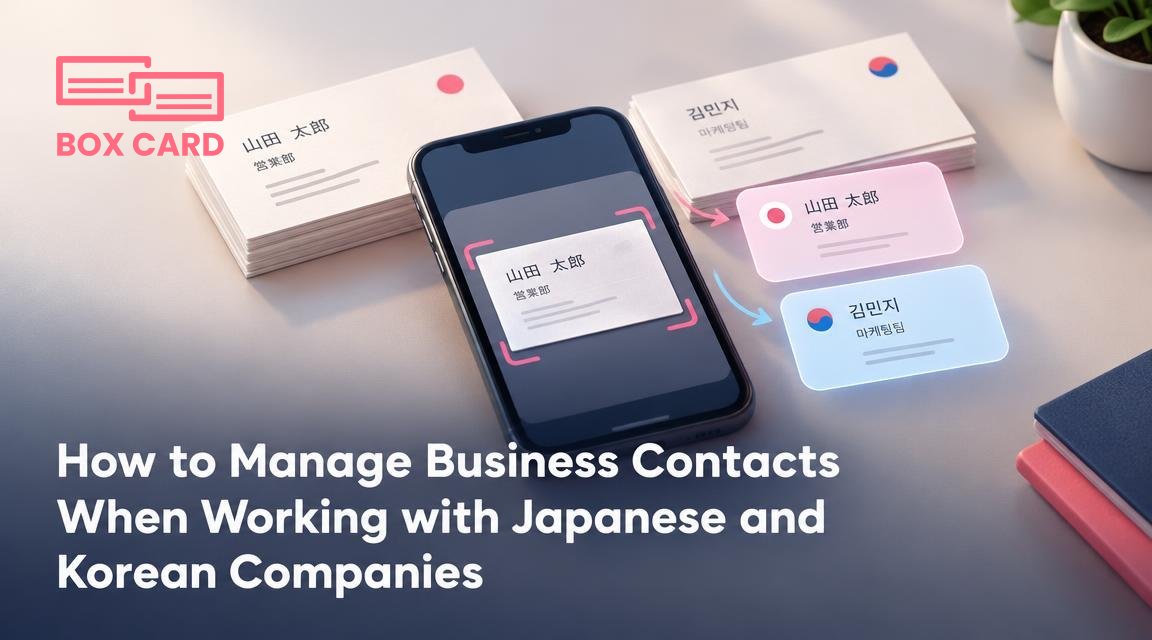
You just returned from meetings with Japanese and Korean partners and now face the messy, important task: how to turn those business cards into usable contacts without causing offense or losing context. Japanese and Korean companies treat business cards as formal introductions and records. If you import them into your database the same way you handle Western cards, you will lose key information, mis-handle names, and damage follow-up chances. This article gives a practical workflow you can use the moment you leave a meeting, plus rules for how to store, tag, and act on those contacts so your team stays accurate and respectful.
Before the meeting: prepare so exchanges go smoothly
Small preparation reduces mistakes when cards are exchanged.
- Learn the correct forms of address. For Japanese companies use -san for most contacts, and for higher ranks use the persons title plus their family name (for example, Tanaka-bucho for a department head). For Korean companies prefer family name plus honorifics such as nim or ssi when appropriate. If you are unsure, use a polite, neutral format in follow-up.
- Bring a card case or sleeve. Present and receive cards with both hands when in Japan, and treat the card as a real extension of the persons identity. In Korea use the same polite handling, but follow the lead of your counterpart if they are less formal.
- Decide which device and app you will use for immediate capture. Plan for business card scanning tools that support Kanji and Hangul, because handwriting or stylized fonts can break generic OCR. Test your chosen app before travel so you know its camera distance and light requirements.
At the exchange: what to record immediately
How you handle the card then determines the quality of the digital record later. Follow this checklist:
- Photograph the card while it is flat, on a neutral surface, straight-on. Take one close scan and one wider shot that shows the meeting context if appropriate.
- Note pronunciation and role. Ask, or repeat the name aloud once and write a phonetic note. Record the persons role in the conversation: decision-maker, technical contact, procurement, local partner. That context is often more useful than a vague title.
- Capture location and meeting purpose. Tag where you met, the event or company office, and the reason you connected. This avoids future confusion when similar names appear.
Why the extra notes matter
Titles and roles in Japanese and Korean firms often imply seniority and approval paths. A director may be a gatekeeper, while a lower-ranked engineer might be the actual technical owner. Recording this distinction changes your next step, whether to send a proposal or schedule a technical demo.
Transcription and romanization: how to store names
Names need at least two fields: the original script and a romanized version. This keeps searches accurate and avoids mis-addressing someone.
- Store the original name exactly as printed in Kanji, Kana, or Hangul. Never discard the original script.
- Add a separate field for name romanization. For Japanese, use Hepburn or the romanization your contact prefers. For Korean, use Revised Romanization unless the contact provides a different spelling. If they offer a preferred Roman alphabet spelling on their card, use that.
- Keep family and given name fields separate. Japanese and Korean name order is typically family name first. When you save a contact in a Western system, put the romanized given name in the given name field so mail merging and salutations work properly.
Example: Card reads Kanji: Tanaka Taro. Store original Kanji in one field, romanized name "Taro Tanaka" in another, family name "Tanaka" and given name "Taro" in dedicated fields.
Organizing data fields and tags that matter
A flat name and phone number are rarely enough. Add these fields and tags to every contact you import from Japan or Korea:
- Original script name
- Romanized full name
- Family name, given name
- Title in original language and in English, with a short explanation (for example, "general manager, procurement")
- Company, department
- Meeting date and location
- Role in buying process: influencer, decision-maker, user, gatekeeper
- Preferred communication channel: email, phone, LINE, KakaoTalk
- Holiday and time zone notes: include major national holidays if relevant
Use tags to mark follow-up urgency, region, product line, and whether a contact is personal or company-level. Tags let local sales teams filter contacts quickly without guessing hierarchy from titles alone.
OCR and accuracy: what to check after automatic capture
Tools that promise perfect business card OCR will save time, but expect errors when processing Kanji, uncommon fonts, vertical text, or cards with mixed scripts. Follow this short quality control routine:
- Verify the original-script field against the card image. OCR can swap characters, especially in vertical Japanese text.
- Check telephone and fax numbers for missing digits and country codes. Add the correct +81 or +82 prefix if missing.
- Confirm email addresses manually. A single character error will bounce your follow-up and appear careless.
- Correct transliteration mistakes. If the romanized name looks wrong, compare it to the original script or to how the person wrote their name in Latin letters on the card.
If you are using business card scanning or business card OCR tools, build these checks into your import workflow so mistakes are found before anyone sends a message.
Follow-up: timing, tone, and channels
When you follow up matters more than the exact words. For Japan and Korea, aim to contact within 48 hours by email unless the meeting expected immediate next steps.
- Start with a short, polite message that references the meeting context and includes the original card image or a photo of the group if appropriate. Japanese and Korean recipients appreciate a formal tone at first contact.
- If you were introduced through a mutual connection, mention the introducer early in the message. This gives social proof and speeds trust building.
- Use the preferred channel. Many Korean professionals use KakaoTalk for quick replies, but accept formal proposals by email. In Japan, email is the standard for formal follow-ups; messaging apps are used but often only after a relationship is established.
Common mistakes and how to avoid them
- Saving only the romanized name. This makes it hard for local colleagues to recognize the contact. Keep the original script.
- Dropping titles. Titles in Japan and Korea convey hierarchy and who should receive certain messages. Keep them in a separate title field and explain them in English if your team does not know the equivalent.
- Immediate public sharing. Do not add a contact to a public sales list or marketing blast without confirming permission. The formality around cards can make unsolicited messages worse than useless.
- Assuming Western name order. Confirm which name is family and which is given before addressing communications.
When to use local helpers and when to keep control
If your company has local staff or partners, involve them early to verify titles, local holiday timing, and the correct level of formality. If you do not have local resources, document every contact carefully and standardize checks so remote teams do not misinterpret roles. Keep control of final messaging templates to ensure legal compliance and consistent branding, but let local experts review tone and translation.
Apps such as Boxcard can help with business card scanning and organizing contacts, but whatever tool you choose, make the process consistent: scan, verify original script, add romanization, tag role and follow-up date, then perform a human review before outreach.
Start with a low-effort rule: every card captured from Japan or Korea must pass a two-minute verification that checks original script, romanization, telephone prefix, and role. That small habit prevents most follow-up errors and preserves respect.

