Can AI Distinguish Between a "Department Manager" and a "Section Manager"? The Decisive Difference Between Conventional OCR and Deep Learning
AI-driven business card scanning with deep learning delivers high-precision digitization beyond the limits of conventional OCR, even for complex formats business cards.
1. The "Pitfalls" of Business Card Scanning: Real-World Failures
A major Japanese trading company used to scan and register approximately 30,000 business cards annually. When they relied on general-purpose OCR, they frequently encountered these critical errors:
- ・Identity Errors: "Ichiro Suzuki" (鈴木一朗) was registered as "Ichiro Suzuki" (鈴木一郎 - using a different kanji), causing him to be treated as a different person.
- ・Title Mismatches: A "Managing Executive Officer" was misread as a "Sales Manager," leading to embarrassing mistakes in job titles on New Year’s greetings.
- ・Search Obstructions: "Takahashi" (髙橋 - ladder-style 'taka') was replaced with the standard "Takahashi" (高橋), preventing unified data searches.
These errors are more than just simple typos; they lead directly to a loss of trust and operational blunders.
2. OCR vs. AI: The Difference Lies in "Contextual Understanding" and "Learning Ability"
Conventional OCR Technology: Pattern Matching
OCR extracts text from images based on pre-defined patterns and fonts.
- ・Pros: Highly accurate for simple cards (horizontal text, standard fonts).
- ・Cons: Struggles with vertical text, handwriting, non-standard fonts, and complex layouts.
Deep Learning AI: "Inferring" Meaning
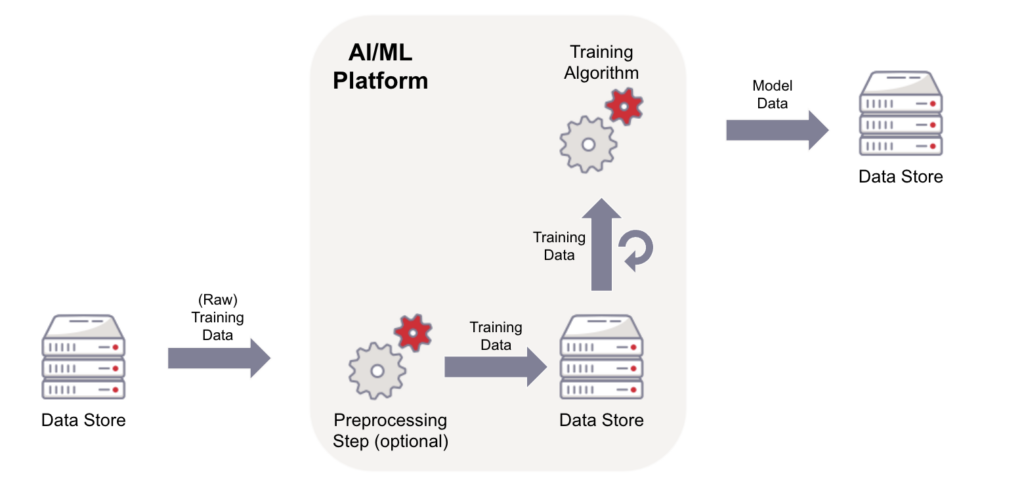
Deep learning AI extracts information by learning from massive amounts of business card data, understanding both context and structure.
- ・Flexibility: Accurately extracts names and company names based on the sequence of departments and titles.
- ・Resilience: Handles minor image defects or printing blurs effectively.
- ・Multilingual: Processes Japanese, English, Chinese, and more seamlessly.
Additional Perspective: Beyond Reading, Toward Understanding Roles
While OCR can read titles like "Department Manager" and "Section Manager" as text strings, it cannot interpret what they imply. Deep learning models, especially when combined with NLP, can statistically infer hierarchy, decision-making authority, and organizational role based on context, surrounding keywords, and historical patterns in training data.
3. Three Key Areas Where the Gap Widens
Mixed Vertical and Horizontal Text
Some cards feature vertical text on the front and horizontal English on the back. Conventional OCR often fails to determine the reading direction, sometimes reading text "upside down." AI estimates the orientation automatically based on layout and character spacing.
Parsing Titles and Positions
Complex titles like "Executive Officer, concurrently Head of Technical Division" are often misidentified by OCR as part of the "Name." AI contextually separates Names from Titles, outputting data in a structure ready for CRM integration.
Additional Perspective: Interpreting Title Hierarchies
Deep learning AI does not just extract titles—it learns patterns such as:
- ・"Department Manager" typically indicating a higher-level managerial role
- ・"Section Manager" often representing a mid-level operational role
It also recognizes variations like "Dept. Manager," "Division Head," or "Team Manager," grouping them into consistent categories while preserving their distinctions for downstream systems.
4. The Decisive Difference: Layout-Based OCR vs. Context-Aware AI
Conventional OCR
- ・Relies on pre-defined regions to extract text
- ・Sensitive to layout changes
- ・Ignores semantic relationships between fields
Deep Learning AI (AI-OCR + NLP)
- ・Learns from large-scale document and business card datasets
- ・Understands relationships between text blocks (name, title, company, contact info)
- ・Uses surrounding vocabulary such as "Dept.," "Division," or "Direct" to infer meaning
- ・Handles abbreviations and inconsistencies as part of learned statistical patterns
This shift—from rule-based extraction to data-driven understanding—is what enables AI to move from “reading text” to “structuring business data.”
5. What It Means for CRM and Business Data
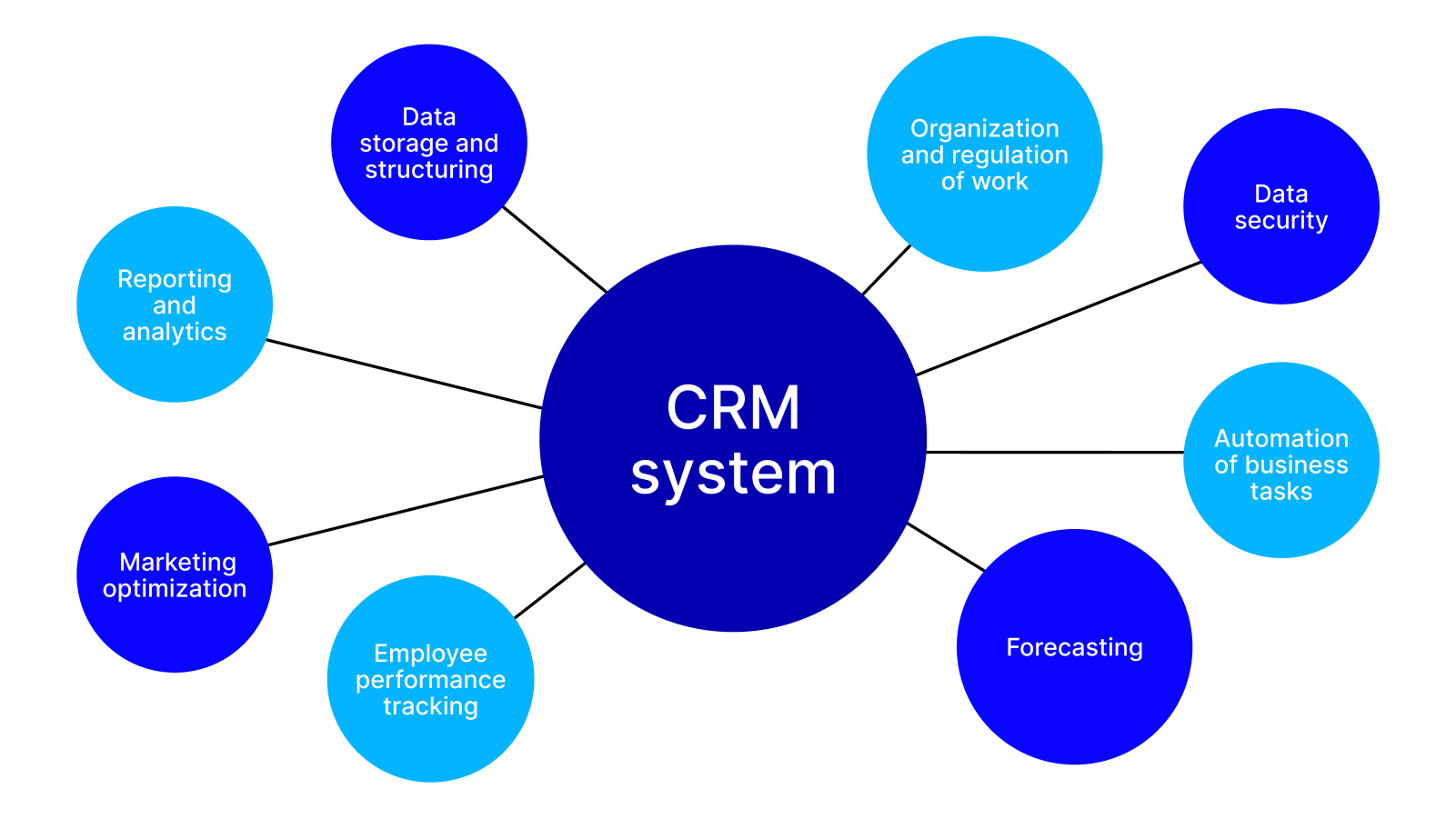
When AI can distinguish not just the wording but the role behind a title, it enables:
- ・Automatic classification of contacts by decision-making level
- ・Cleaner, deduplicated databases despite variations in spelling or formatting
- ・More precise segmentation for marketing campaigns and sales outreach
In contrast, relying on conventional OCR often results in fragmented records, inconsistent titles, and increased manual data cleaning efforts.
6. For Companies Considering Adoption: 4 Key Perspectives
Perspective | Conventional OCR | Deep Learning AI |
Vertical/Complex Layouts | Unstable | Stable processing |
Old/Variant Characters | Automatically converted | Original notation maintained |
Title/Department Separation | Nearly impossible | Natural separation |
Multilingual/CRM Sync | Limited | Highly scalable |
5. Boxcard - The AI-Powered Business Card Optimization App
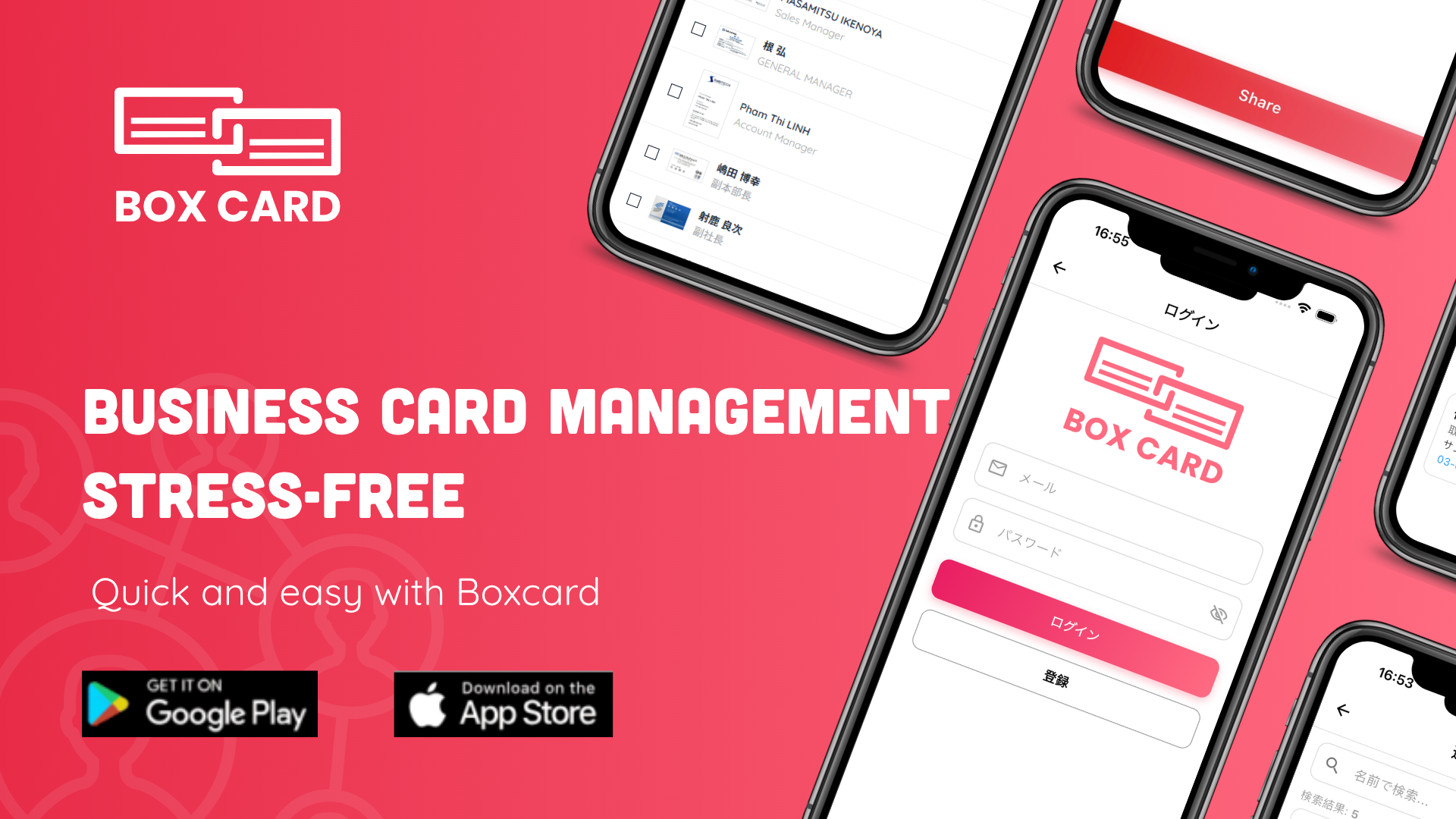
“Business card apps sound useful, but they’re often complicated, slow, or eventually require payment.”
If you’ve ever felt this way, BoxCard is a great option to consider.
Boxcard is designed with three key strengths in mind: simplicity, lightweight performance, and free access, making it easy for anyone to get started right away.
・Easy to use: Intuitive interface with no complicated setup
・Lightweight and fast: Smooth performance without lag
・Free to use: Core features available without hidden costs
・Multilingual support: Supports English, Japanese, Vietnamese, Korean, and Chinese (Simplified & Traditional)
What Makes BoxCard Different?
Many business card management apps offer advanced features but come with trade-offs such as high costs, complex interfaces, or heavy performance.
BoxCard takes a different approach by focusing on essential functionality with a seamless user experience:
・Streamlined workflow with minimal setup
・Fast scanning, organizing, and searching
・Core features fully accessible without requiring payment
As a result, BoxCard stands out by offering a balance between usability, performance, and cost-efficiency.
This makes it especially useful for professionals handling multilingual business cards or working in international environments.
Who Should Use BoxCard?
・Beginners looking for a simple solution
・Users who want a free and efficient tool
・Professionals managing multilingual contacts
・Anyone who prefers lightweight and easy-to-use apps
👉 Download BoxCard now on the App Store or Google Play and start managing your business cards more efficiently.
Accurate digitalization of business card info is a vital element for maintaining customer relationships. Deep learning AI offers the flexibility and precision required for unique Japanese formats that conventional OCR simply cannot match. To evolve from "storing" to "utilizing" data, AI technology is no longer optional—it is essential.
